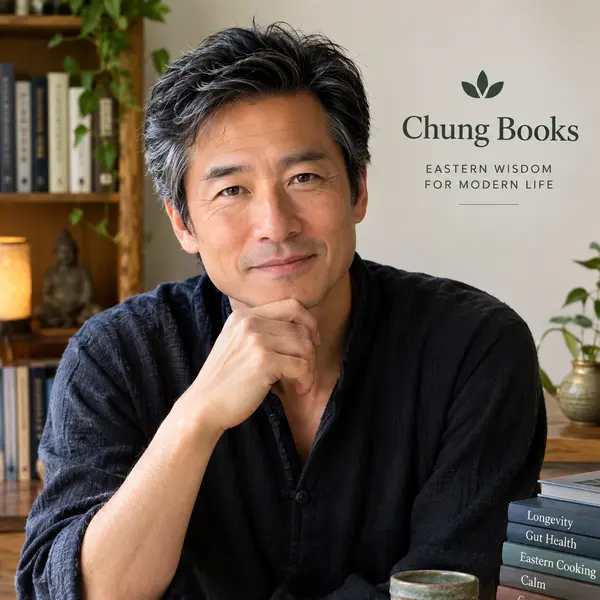
About Chung H.
Who I am. Chung H. is a pen name. Behind it is one person: an independent researcher and writer based in France, with no institutional affiliation, who has spent years reading the primary literature on Eastern wellness practice and writing about what holds up against it. I research, draft and edit every title in the Chung Books catalog and everything on this site. I hold no medical or Traditional Chinese Medicine qualification, I have never trained clinically, and I do not diagnose, prescribe or treat anyone. What I do is read the sources carefully, cite them, and stay honest about the line between what is established and what is only tradition. This website is the official home for that work: the place to read free companion material, browse the full catalog, and see exactly how each book's claims are sourced.
What I write about. Eastern wellness practice translated into something usable: Yang Sheng, Traditional Chinese Medicine, Japanese longevity culture, qigong, seasonal eating, fermentation, sleep and the daily rhythms that traditional systems built entire frameworks around. Not folklore repackaged as content, and not wellness aesthetics. Practices, examined.
Why I write. Most of what passes for “ancient wisdom” online is either dismissed outright or accepted uncritically, and both responses skip the actual work. I write because that gap is worth closing: taking traditions that mapped the body through centuries of sustained observation and checking, point by point, what still holds against modern data.
My editorial philosophy. Every claim in a Chung Books title falls into one of three categories: supported by evidence, traditional but untested, or contradicted by current research. I say which is which. If a practice cannot be traced to a mechanism or a body of observation, it does not get presented as fact. It gets named as tradition, and left at that.
Areas of interest. Traditional Chinese medicine and the organ-clock model of circadian rhythm. Taoist longevity practice and qigong. Japanese daily ritual: tea, breakfast structure, hara hachi bu, ikigai. Fermentation and gut health across Japanese and Korean tradition. Sleep, stress and the nervous system through an Eastern lens. The throughline across all of it is rhythm and maintenance, not intervention and repair.
My books. More than forty titles in English and French, across six series, covering longevity, Eastern cooking, gut health, sleep and calm, and targeted resets for specific conditions. They are self-published through Amazon Kindle Direct Publishing; the full catalogue is on my Amazon author page. Each one is written to stand alone. A reader who buys a single title should not need the other thirty-nine to get value from it.
Traditional knowledge and modern evidence. I treat these as two independent sources of information about the same body, not as competing belief systems. Traditional practice gets credit for what it noticed correctly, long before there was a mechanism to explain it. Modern research gets the final word on what actually holds up. Where the two agree, that is the strongest claim I can make. Where they do not, I say so plainly and let the reader decide what to do with a practice that is old but unproven.
What you'll find on this site. Free long-form articles on the same topics as the books, organized by subject in the Journal; a full library of every Chung Books title with honest descriptions; and a handful of interactive tools (a Qigong routine, a circadian planner, a diet guide) built to put the written material into practice. Nothing on this site requires a purchase to be useful.
How this site relates to the books. The articles here are not excerpts or advertisements. Each one stands on its own and covers its subject in full. Where a book goes deeper into a topic, an article says so directly and links to it, the way one chapter might point to another. The site exists first; the books are for readers who want a single subject treated at full length in one place.
Chung H. is a writer and independent researcher, not a physician and not a qualified practitioner of Traditional Chinese Medicine. Nothing published by Chung Books is medical advice, diagnosis or treatment, and every article carries that notice. Readers with health conditions should consult a qualified clinician.
What this publisher is for
Most writing about Eastern wellness falls into one of two failures. It either treats the traditions as unquestionable ancient wisdom, or it dismisses everything that cannot be reduced to a randomised trial. Both are lazy, and both are unhelpful to someone simply trying to sleep better.
The aim here is a third position: take the traditions seriously as accumulated observation, test their claims against what is now known, and report the result honestly — including when the result is that a much-loved practice has no support.
How the research works
Each guide follows the same sequence.
| Step | What happens |
|---|---|
| Primary sources | Classical texts where relevant — the Huangdi Neijing, Sun Simiao, Japanese dietary writing — read for what they actually say rather than how they are usually summarised. |
| Contemporary literature | Systematic reviews and trials where they exist. Interventional studies are weighted above observational ones, and that distinction is made visible to the reader. |
| Identify the gap | Most traditional claims have no controlled research. That is stated rather than filled with plausible-sounding language. |
| Practical translation | What a reader can do on an ordinary Tuesday. If a practice cannot be described concretely, it does not go in. |
| Cut | The last step is removal. Anything that cannot be supported, or that only sounds good, comes out. |
Editorial standards
Applied to every article in the Journal and every book:
- Evidence is labelled. Readers are told which claims have solid support, which are traditional, and which are contested.
- Popular overstatements are corrected. Where a widely repeated claim outruns the data — the gut-serotonin-and-mood argument, the Firmicutes-to-Bacteroidetes obesity ratio — the article says so, even when the correction is less exciting than the myth.
- Sources are named. Every guide ends with references a reader can check.
- Medical boundaries are explicit. Symptoms warranting a clinician are named specifically, not gestured at.
- Nothing is withheld. Free guides are complete. No article stops short to sell the book.
What we will not do
- Promise that a food, herb or practice treats a diagnosed condition.
- Publish sponsored articles or paid product reviews.
- Recommend supplements where food does the same job, which is most of the time.
- Use the language of detoxification, cleansing or resetting the body in the marketing sense.
- Present a rodent study as though it were a human finding.
- Suggest that anything here should replace or delay medical care.
This site carries advertising and links to its own books through Amazon. Those are the only commercial relationships. No third party has ever paid for coverage, and no article has been altered to suit an advertiser.
The library
Forty-five titles across six series, plus sixteen free guides in the Journal.
| Series | Subject |
|---|---|
| The Yang Sheng Library | The foundational philosophy — tea, movement, nourishing life |
| Eastern Wellness & Calm | Stress, sleep and nervous system regulation |
| Eastern Nutrition & Kitchen | Japanese and Chinese cooking, fermentation, the pantry |
| Eastern Healing & Longevity | Ageing, inflammation, the gut, the organ clock |
| Eastern Women’s Wisdom | Cycle, fertility and menopause within the traditional framework |
| The Quiet Practices | Attention, minimalism, presence and contemplative work |
Corrections
Articles are revised when better evidence appears or when a reader identifies an error. The last-updated date at the top of each guide reflects the most recent substantive revision, not a cosmetic edit. If you spot something wrong, write in — corrections are made and the date changed.
Contact
Write to us
Questions about a book, a practice or a recipe. Press enquiries, translation rights, speaking requests. Corrections. All to the same address.
Replies usually within three working days. Slowly, and on purpose.
Questions
Who writes Chung Books?
Chung H. is a pen name. Every title in the library and every article in the Journal is written by the same author, in English and French.
What qualifies you to write about health?
Chung is a researcher and author, not a licensed clinician. The books and articles are works of research and synthesis — reading primary sources in traditional medicine alongside contemporary studies, and reporting where they agree and where they do not. Nothing published here is a substitute for professional medical advice, and that is stated on every article.
Why Eastern wellness specifically?
Because these traditions accumulated detailed observational knowledge about sleep, food, movement and stress over roughly two thousand years, and much of it has held up. The interesting work is separating what survived scrutiny from what did not, rather than accepting or dismissing the whole.
Do you believe in qi?
Qi is treated here as a useful traditional vocabulary for felt experience, not as a claim about a measurable substance. Readers do not need to accept the metaphysics to benefit from the practices, and the writing is careful to keep the two apart.
How do you decide what is evidence-based and what is not?
Every article distinguishes three categories: findings with solid modern support, traditional claims with little or no controlled research, and areas where evidence is genuinely mixed. Where a popular claim outruns the data — the serotonin-and-mood argument, for example — that is stated plainly rather than omitted.
Are the articles free?
Yes, permanently. Every guide in the Journal is complete and free to read. The books exist for readers who want the subject developed at length, but no article is a teaser and none withholds its conclusion.
Do you accept sponsored content or paid reviews?
No. No article on this site is paid for, sponsored, or written in exchange for products. The site carries advertising and links to its own books; those are the only commercial relationships.
What is your position on supplements?
Sceptical by default. The articles generally recommend food over supplementation, and say directly where supplement evidence is weak — as in the gut microbiome guide, which advises most healthy readers to skip probiotic products in favour of fermented foods.
Can I translate or republish an article?
Contact us first. Translation rights and republication are handled case by case, and permission is usually granted for non-commercial educational use with attribution.
How can I suggest a topic?
Write to contact@chungbooks.fr. Reader questions have prompted several articles, and specific practical questions are the most useful kind.
How often do you publish?
Irregularly and deliberately. Articles are published when they are finished rather than to a schedule, because a guide of this length takes time to research properly.
How do I contact you?
contact@chungbooks.fr. Replies usually come within three working days.
A note on health. Chung Books publishes educational material. It is not medical advice, diagnosis or treatment, and the author is not a licensed clinician. Traditional concepts such as qi and the Five Elements are presented as historical frameworks, not biomedical facts. If you are pregnant, managing a condition, taking medication or recovering from illness, consult a qualified professional before changing your routine, and never delay medical care on the basis of anything published here.