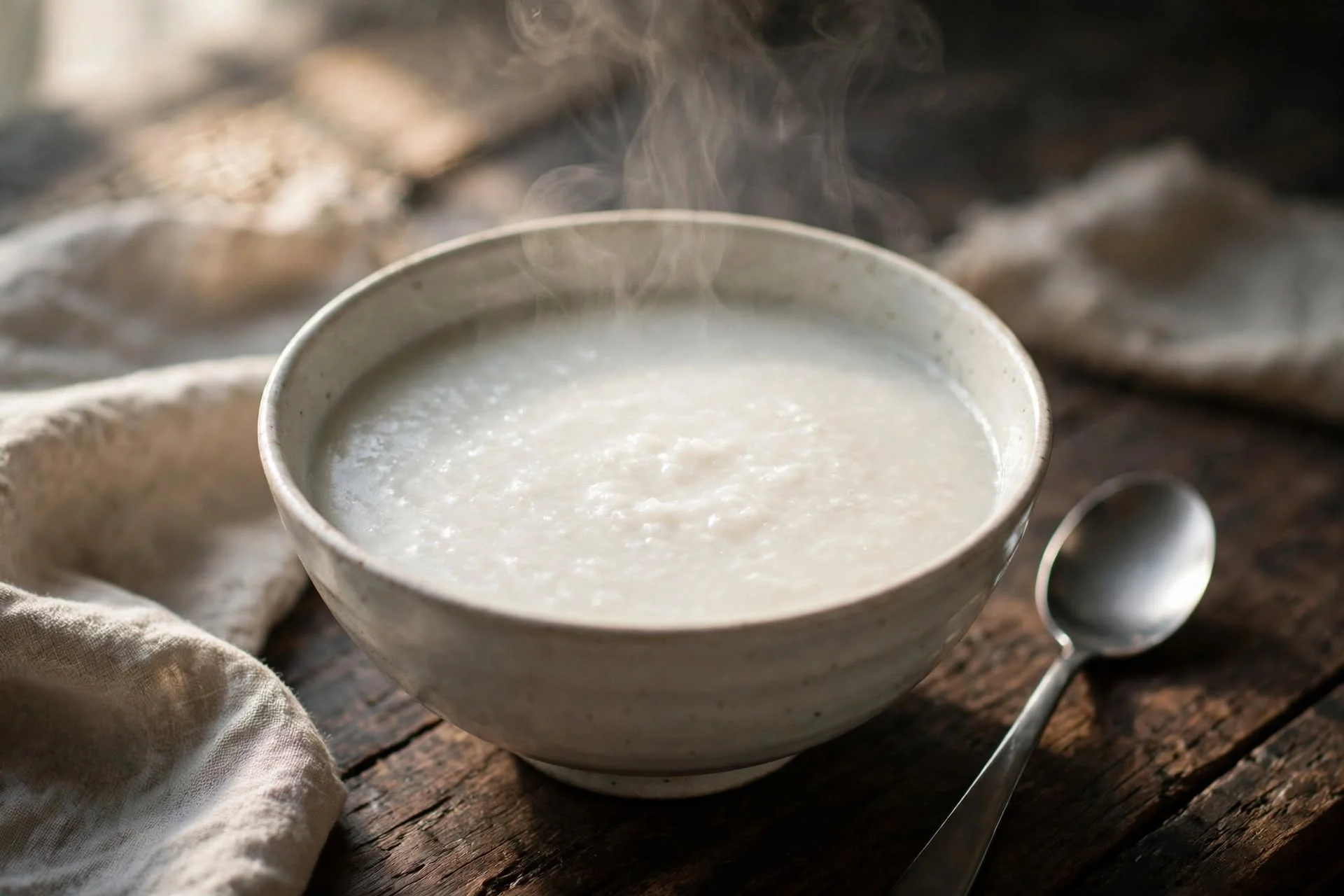
There is a version of breakfast that asks nothing of you except time. One cup of rice. Ten cups of water. An hour on low heat, mostly unattended. What comes out the other end — congee, called jook in Cantonese and zhou in Mandarin — is one of the oldest continuously prepared breakfasts on earth, and arguably still one of the best.
What congee actually is
Congee is rice cooked in far more water than usual, for far longer than usual, until the grains break down into a thick, smooth porridge. That is the entire technical description. What that simple process produces, though, is a food that is unusually easy to digest, gentle on the stomach even when it is unsettled, and — because it absorbs flavor so readily — endlessly adaptable to whatever you have on hand.
In Chinese households, congee is often the first food given to babies, the standard meal for anyone recovering from illness, and, for millions of people, simply what breakfast has always meant. That triple role — nourishing, gentle, and ordinary — is exactly why it has survived for well over a thousand years while trendier breakfasts have come and gone.
Why "quiet" is the right word for it
Most breakfasts announce themselves: the crunch of toast, the sharpness of coffee, the sweetness of pastry. Congee does none of this. It is soft, mild, and warm, and eating it slows you down almost by necessity — there is no fast way to eat a bowl of rice porridge. That physical slowness has a psychological effect that Traditional Chinese Medicine has long recognized: a meal that cannot be rushed tends to produce a morning that is not rushed either.
This is not incidental to congee's design. TCM treats the stomach as needing to be "warmed into" the day rather than shocked into it, and a bowl of congee, eaten slowly and mindfully, is close to the physiological opposite of the standing-at-the-counter, coffee-and-scroll morning that has become the modern default.
The basic method
Ingredients: short- or medium-grain rice, water or light stock (ratio of about 1 part rice to 8–10 parts liquid).
The classic ratio is one part short- or medium-grain rice to eight to ten parts water or light stock — more water produces a smoother, thinner congee; less produces something closer to a thick porridge. Rinse the rice, combine it with the liquid in a heavy pot, bring it to a gentle boil, then reduce to the lowest possible simmer and let it cook, stirring occasionally, for forty-five minutes to an hour, until the grains have broken down and the texture is smooth and slightly thickened.
That is genuinely the whole method. The active effort is perhaps five minutes; the rest is patience. A slow cooker or rice cooker with a porridge setting will do most of the waiting for you overnight, so that a finished pot is ready when you wake up — which is, for many people, the version of this recipe that actually survives contact with a real weekday.
What goes on top
Plain congee is a canvas, not a finished dish, and this is where the recipe earns its place as an everyday breakfast rather than an occasional novelty. A few traditional and simple additions:
Savory, warming. A soft-boiled egg, a few slices of ginger cooked into the pot, a drizzle of sesame oil, scallions, and a splash of soy sauce. This is the closest to a traditional Cantonese breakfast bowl.
Gut-focused. A spoonful of fermented tofu or pickled vegetables stirred in at the end, adding both flavor and a small dose of live cultures — echoing the same fermented-food logic found in Japanese breakfast traditions.
Simple and mild. Just a pinch of salt and a few drops of sesame oil, eaten plain when the stomach needs the gentlest possible meal — this is the version most often given to someone recovering from illness or a difficult night's sleep.
Why it earns a place in a modern kitchen
Congee will never trend the way a green smoothie or a protein-packed overnight oats jar trends, and that is, in a sense, the entire point. It is not designed to photograph well or to signal effort. It is designed to be easy on a body that has been asleep for eight hours and is not yet ready for anything demanding — which describes almost everyone's stomach at seven in the morning, whether modern nutrition culture acknowledges it or not.
If your current breakfast is coffee and whatever is fastest, congee is not a small substitution. It is a genuinely different relationship with the first meal of the day — slower to make, gentler to eat, and, for many people who try it consistently for even a week, noticeably calmer to live with.
The Japanese Soup Bible and A Quiet Kitchen both build on this same principle — warm, simple, unhurried food as a daily practice rather than an occasional indulgence — with dozens of bowls designed around exactly this kind of quiet nourishment.
Related reading: the same slow, unhurried attention applies to what you drink, not just what you eat — see the three teas everyone should know.