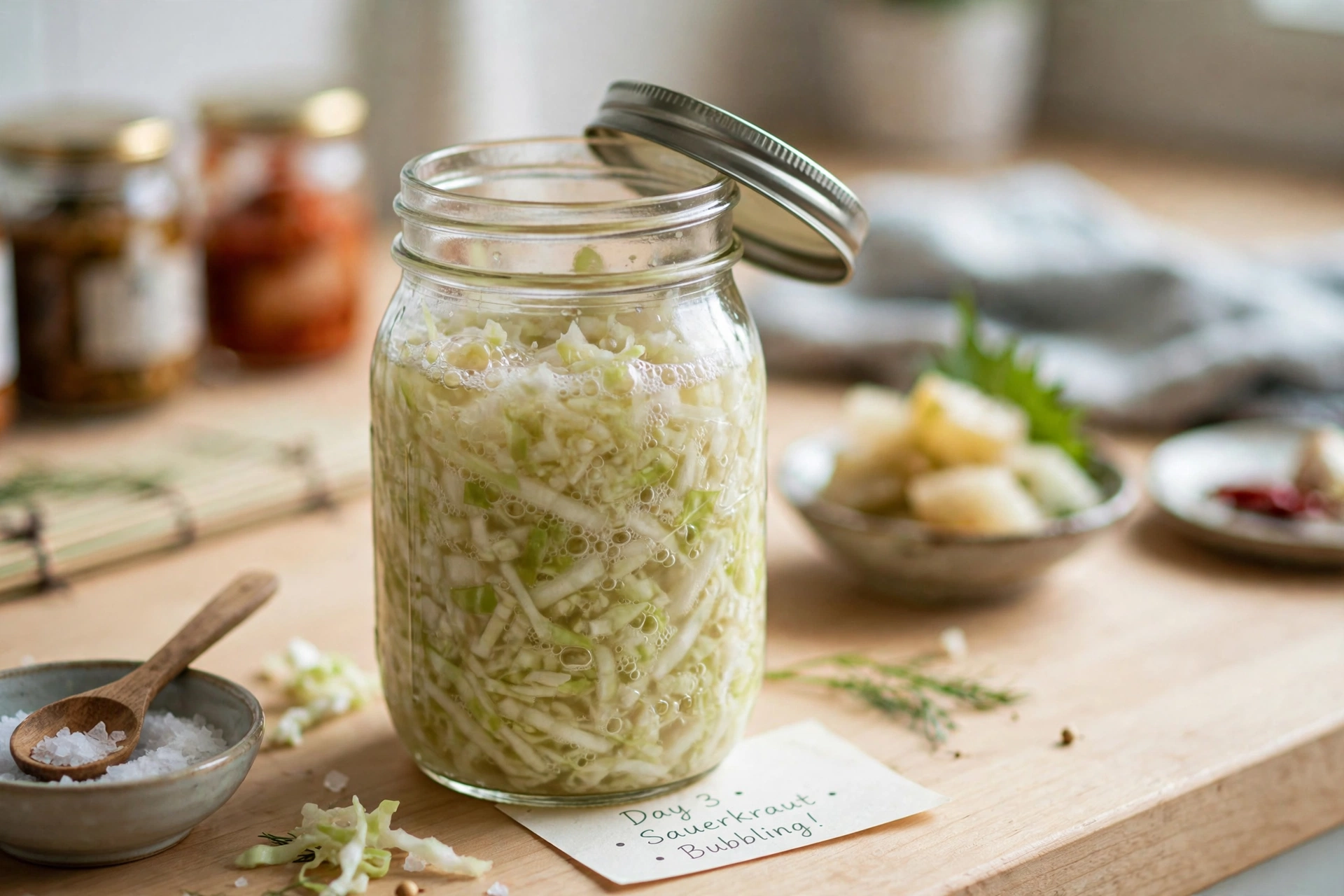
Most people's first encounter with home fermentation is a jar of something that went badly wrong. A batch of sauerkraut that grew fuzzy mold. A ginger bug that smelled like it belonged nowhere near a kitchen. It's enough to put a reasonable person off the entire idea, which is unfortunate, because properly done, fermentation is one of the safest and oldest food preservation methods in human history, and the traditional foods it produces are behind some of Chung Books' most requested topics: kimchi, miso, and the wider world of Japanese pickles, or tsukemono.
This guide skips the theory-heavy explanations and gets straight to a first project that's genuinely hard to get wrong, then explains the handful of principles that make every other ferment make sense.
Why salt does almost all the work
Nearly every beginner ferment relies on the same basic principle: salt creates an environment where beneficial, salt-tolerant bacteria (mainly lactobacillus species) can thrive, while most harmful bacteria cannot. This is called lacto-fermentation, and it's the method behind sauerkraut, kimchi, most pickles, and many Japanese tsukemono.
The salt does two jobs at once. It draws water out of the vegetables through osmosis, creating a natural brine, and it suppresses the growth of unwanted microorganisms long enough for the beneficial bacteria to establish themselves and begin producing lactic acid, which then continues to protect the ferment as it sours. Once you understand this, most fermentation "rules" stop feeling arbitrary. They exist to keep the salt concentration and the vegetables submerged, which is really the whole game.
Your first ferment: simple salt-brine vegetables
This is close to a simplified version of Japanese shiozuke, one of the most basic forms of tsukemono, and it's a forgiving, low-risk place to start.
What you need:
- A clean glass jar with a lid (a repurposed pickle jar works fine)
- Vegetables: cucumber, radish, carrot, or cabbage are all reliable choices
- Non-iodized salt (fine sea salt or pickling salt; iodized table salt can sometimes interfere with fermentation and discolor vegetables)
- Filtered or boiled-and-cooled water if your tap water is heavily chlorinated
Method:
- Make a brine at roughly a 2 to 3 percent salt concentration. That's about 20 to 30 grams of salt per liter of water, or, for a rough kitchen measure, about 1.5 to 2 tablespoons of salt per 4 cups of water.
- Cut your vegetables into pieces small enough to submerge easily in your jar.
- Pack them into the jar and pour the brine over until fully covered. This last part matters more than almost anything else: any vegetable poking above the brine line is exposed to air and is where mold will start.
- If pieces float, use a small clean weight (a smaller jar filled with water, or a fermentation weight if you have one) to keep everything submerged.
- Leave the jar at room temperature, loosely covered so gas can escape, for 3 to 7 days, tasting daily after day 3.
- Once it tastes pleasantly sour to your liking, move it to the refrigerator, which dramatically slows fermentation and lets you control the final flavor.
What's normal and what's not
New fermenters are often unsure what they're looking at, understandably, since it looks nothing like normal food. A few clarifications:
- Cloudy brine and small bubbles are normal. This is fermentation activity, exactly what you want to see.
- A thin white film on the surface (kahm yeast) is usually harmless, though it can affect flavor if left too long. It can generally be skimmed off.
- Fuzzy mold in any color (green, black, pink, or otherwise) means the batch should be discarded. This is rare when vegetables stay fully submerged, which is precisely why that step matters so much.
- A pleasant sour, slightly effervescent smell is what you want. An unpleasant, rotten, or genuinely foul smell (as opposed to simply pungent, since some ferments are naturally strong-smelling) is a sign something went wrong.
When in doubt, the old fermentation adage still holds: if it smells wrong, looks wrong, or you have any real hesitation, it's not worth the risk. Properly done lacto-fermentation is very safe, but "properly done" is doing some work in that sentence.
Beyond the first jar: where Japanese fermentation goes next
Once basic salt-brine vegetables feel comfortable, Japanese fermentation traditions open up a much wider world, most of which uses more specific cultures rather than plain salt brine:
- Nukazuke, vegetables fermented in a bed of seasoned rice bran that's maintained (fed and stirred) over months or years, developing complex, deeply savory pickles.
- Natto, fermented soybeans using a specific bacterial culture (Bacillus subtilis), known for its distinctive sticky texture and strong flavor, an acquired taste for many newcomers.
- Amazake, a lightly sweet fermented rice drink made using koji, the same mold culture behind miso and soy sauce.
These are meaningfully more advanced than a salt-brine jar and generally require either a starter culture or an established nuka bed, which is worth knowing before assuming you can replicate them with the method above.
Fermentation and gut health: what's established, what's still being studied
Fermented foods have become closely associated with gut health in the past decade, and there's real substance behind the connection: fermented foods can introduce live beneficial bacteria and their metabolic byproducts to the digestive system, and some studies have found associations between regular fermented food consumption and markers of gut microbiome diversity.
What's less settled is how much benefit survives digestion, how it varies between specific ferments and individuals, and whether homemade ferments, which are far less standardized than commercial probiotic products, deliver comparable effects. This is an active area of ongoing research rather than a closed case. It's reasonable to eat fermented foods because they're genuinely delicious, deeply traditional, and plausibly beneficial, without needing to treat them as a guaranteed medical intervention.
Frequently asked questions
Do I need special equipment to start fermenting?
No. A clean glass jar is enough for your first several attempts. Specialized fermentation weights, airlock lids, and crocks become useful once you're fermenting regularly, but they're not required to begin.
How do I know if a ferment has gone bad versus just looking unusual?
Trust smell over appearance in most cases. Bubbles, cloudiness, and a sour smell are normal. Fuzzy mold of any color, or a genuinely rotten smell, means discard it.
Can I ferment vegetables without any salt?
Not safely for most beginner methods. Salt is doing real protective work, not just adding flavor, and salt-free "fermentation" is much more prone to unwanted bacterial growth. This is not the place to improvise.
How long do homemade ferments last once refrigerated?
Most lacto-fermented vegetables keep well for several months refrigerated, continuing to slowly develop flavor, though they're usually at their best within the first few weeks after fermentation slows down in the cold.
Start with one jar
Fermentation has a reputation for being finicky that it mostly doesn't deserve. The core method, salt, submersion, and time, has worked reliably across cultures for thousands of years, long before anyone understood the microbiology behind it. Start with one simple jar of salt-brine vegetables, pay attention to what happens, and the logic behind kimchi, miso, and every other traditional ferment on this site will make a great deal more sense.
For a full guided path into Japan's specific fermentation traditions, from miso and soy sauce to nukazuke and amazake, The Japanese Fermentation Bible covers the 2,000-year system this article only introduces.
Related reading: Kimchi, Miso: White, Red and Hatcho — and Why You Never Boil It, Understanding the Gut Microbiome, and Congee, Not a Cleanse: the Chinese Way to Settle a Weak Stomach, and the role of fermented foods in the Okinawan diet.