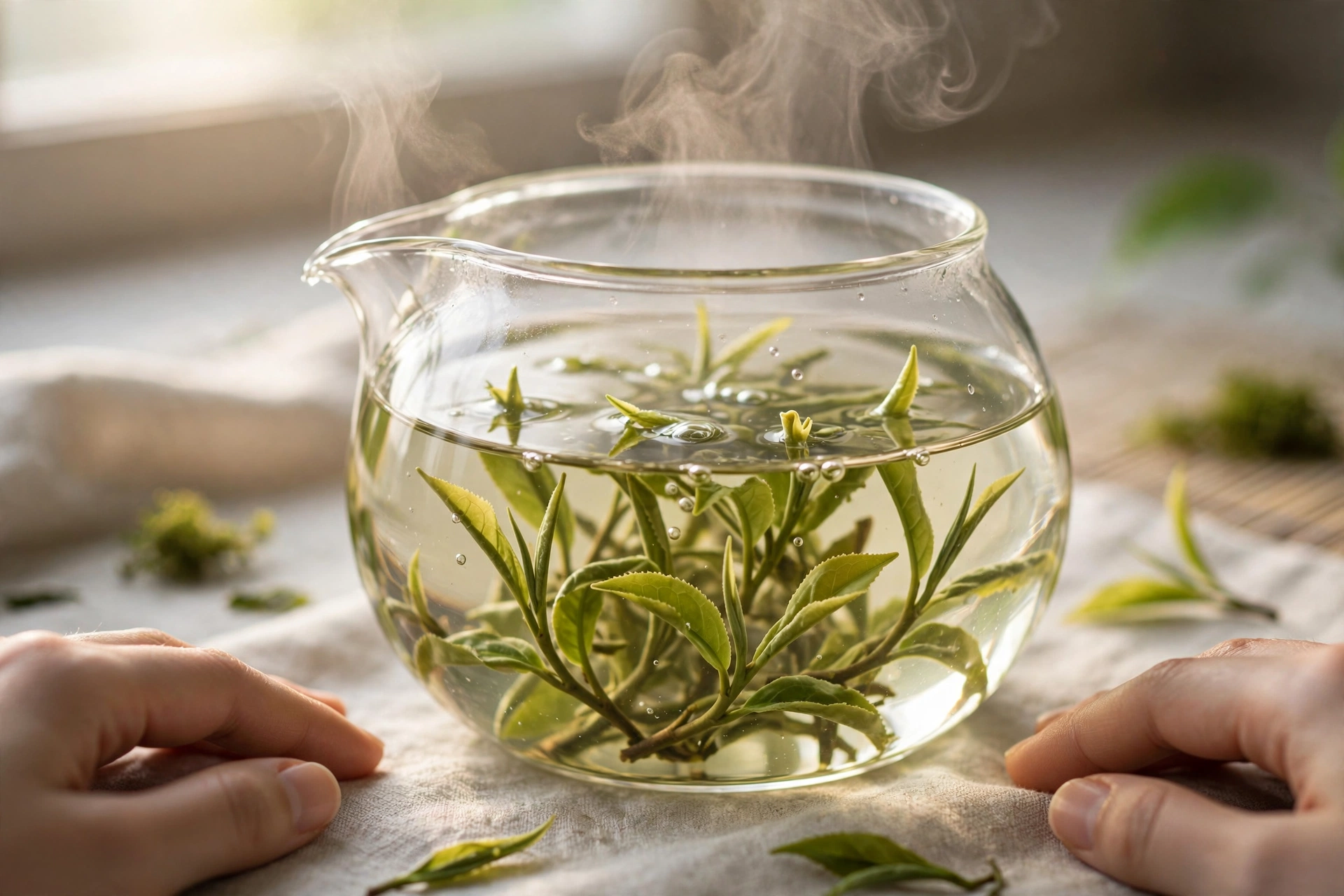
Water at eighty degrees, poured over leaves that have been rolled and dried and are now unfurling. The steam carries something grassy and faintly sweet. Nothing is required of you for the next three minutes except waiting.
That waiting is not incidental to the effect. It may be half of it.
The molecule that makes tea unusual
L-theanine is an amino acid found in meaningful quantities in almost nothing else humans eat. It crosses the blood brain barrier, and EEG studies consistently show it increases alpha wave activity, the brain’s signature of relaxed alertness.
Alpha is not sedation. It is the state of a mind that is awake and not scanning for threat. Anyone who has watched someone read absorbed in a chair has seen it from the outside.
Why tea does not feel like coffee
Tea and coffee both deliver caffeine. The subjective difference is not imagined.
Studies pairing L-theanine with caffeine find a different profile than caffeine alone: attention improves while the jittery, sympathetically driven edge is reduced. The theanine appears to smooth the curve rather than flatten it.
Green tea and matcha carry the highest theanine loads. Shaded teas such as gyokuro carry more still, because shading the plant before harvest raises theanine and lowers the catechins that make tea bitter.
The part the chemistry does not explain
Here is the honest limit of the molecular story. Theanine doses in trials are typically 100 to 250 milligrams. A cup of green tea supplies perhaps 20 to 40.
Which means the calm most people feel from a tea ritual is not principally pharmacological. It is behavioural, and it comes from the shape of the thing.
What the ritual is doing
- It enforces a pause. Steeping cannot be hurried. For three minutes there is a legitimate reason to do nothing.
- It occupies the hands. Warmth held in both palms is a direct tactile signal, and it is difficult to type while holding a bowl.
- It engages smell before taste. Olfactory input reaches the limbic system quickly, without much cortical processing in between.
- It repeats. A cue that arrives at the same time each day becomes a boundary in the day rather than an event.
Chanoyu, the Japanese way of tea, formalised all four into a choreography. Gongfu cha in China arrived at a similar answer through small pots and repeated short infusions. Neither tradition had access to EEG. Both concluded that the preparation mattered as much as the drink.
Choosing by time of day
- Morning: sencha or matcha. High theanine, enough caffeine to be useful.
- Afternoon: oolong. Lower caffeine, long finish, several infusions from the same leaves.
- Evening: aged pu-erh or roasted hojicha. Hojicha is roasted at high temperature, which drives off much of the caffeine, and it tastes like toasted grain.
Water temperature matters more than most people expect. Boiling water on delicate green tea extracts bitterness and little else. Seventy to eighty degrees is the range worth learning.
The invitation
This evening, make one cup of hojicha or any roasted tea, and do the steeping without your phone in the room. Not the drinking. The steeping.
Three minutes of standing near warm water with nothing to do is the whole practice. The tea is almost a pretext.
Written for education and reflection. Nothing here replaces advice from a qualified practitioner.