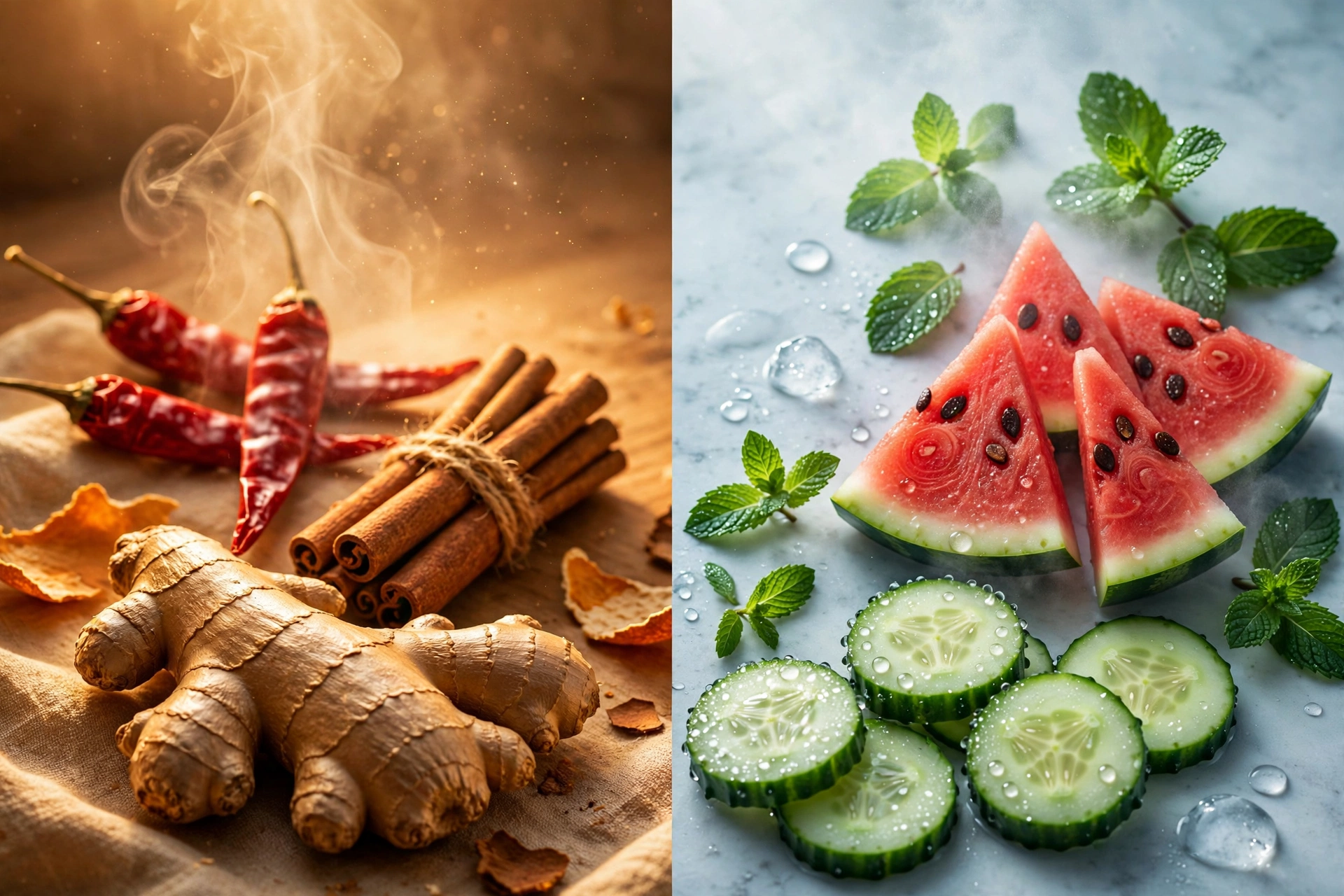
Long before "anti-inflammatory diet" became a wellness marketing phrase, Chinese medicine was already sorting food into categories meant to cool the body's internal heat, a concept that overlaps, imperfectly but genuinely, with what modern biology now calls inflammation.
Cooling, warming, and what they actually mean
TCM's food classification system sorts ingredients as cooling, neutral, or warming, based on their observed effect on the body rather than any lab measurement. Foods associated with "heat," redness, swelling, irritability, are traditionally addressed with cooling foods: mung bean, cucumber, bitter melon, chrysanthemum. It's tempting to map this directly onto inflammation, but that's an oversimplification worth naming honestly. Not everything the tradition calls "hot" corresponds to what modern medicine measures as inflammatory, and the reverse is also true. The genuine overlap is narrower, and more interesting, than a clean one-to-one translation.
Where the overlap is real
Ginger. Classified as warming in TCM, yet one of the best-studied anti-inflammatory foods in modern research. Its active compound, gingerol, inhibits inflammatory pathways (COX-2 and pro-inflammatory cytokines) in multiple lab and human studies, and clinical trials show measurable reduction in markers like CRP in some populations. The TCM classification (warming) and the modern finding (anti-inflammatory) don't map neatly onto each other, a useful reminder that "warming" in TCM is not synonymous with "inflammatory" in biomedicine.
Turmeric (curcumin). One of the most heavily studied plant compounds in the anti-inflammatory research space. Multiple meta-analyses show curcumin supplementation reduces inflammatory markers and improves symptoms in conditions like osteoarthritis, with effect sizes in some trials comparable to low-dose NSAIDs. The catch: curcumin has poor bioavailability alone, most positive trials use enhanced-absorption formulations (with piperine or lipid-based delivery), worth knowing before assuming turmeric tea alone replicates the studied effect.
Reishi mushroom. Traditionally used to "calm" and build resilience. Modern research shows real immunomodulatory effects, some anti-inflammatory, some immune-stimulating, with polysaccharide compounds showing activity in cell and animal studies. Human trial evidence remains more limited than for turmeric or ginger; promising but earlier-stage.
Green tea (catechins). Traditionally cooling, and consistently linked in observational and interventional studies to reduced inflammatory markers, likely via its EGCG polyphenol content, one of the more robustly replicated findings in this entire category.
Where the tradition outpaces the evidence
- Bitter melon for "clearing heat." Some evidence for blood sugar effects, but direct anti-inflammatory marker studies in humans are sparse.
- Broad "cooling food" lists applied indiscriminately. Cucumber and watermelon are traditionally cooling, but no trial tests whether eating them reduces measurable inflammation; they may simply be part of a generally lighter, more hydrating dietary pattern.
A grounded daily approach
The foods with the strongest actual mechanism data, ginger, turmeric with a bioavailability booster, green tea, and reishi where tolerated, are worth incorporating regularly, not as medicine, but as part of an overall dietary pattern. None of them work as a single dramatic fix; the research consistently shows modest, cumulative effects that build over weeks of consistent use, matching how the tradition itself always framed food: as a daily practice, not a treatment.
Chronic inflammation with symptoms, joint pain, fatigue, digestive issues, deserves proper medical evaluation. Food can support a treatment plan; it should not replace diagnosis of what's actually driving inflammation in the first place.
Sources referenced
Ginger and turmeric are the two items here with meta-analytic support for lowering inflammatory markers. Curcumin's effect depends heavily on enhanced-absorption formulations; plain turmeric powder is poorly absorbed.
- Morvaridzadeh M, Fazelian S, Agah S, et al. Effect of ginger (Zingiber officinale) on inflammatory markers: a systematic review and meta-analysis of randomized controlled trials. Cytokine 2020;135:155224.
- Daily JW, Yang M, Park S. Efficacy of turmeric extracts and curcumin for alleviating the symptoms of joint arthritis: a systematic review and meta-analysis of randomized clinical trials. J Med Food 2016;19(8):717–729.
This essay reflects general wellness traditions and is not medical advice. It should not replace guidance from a qualified healthcare professional, particularly for existing health conditions.
Want the full practice, not just the essay? Get the free 7-Day Eastern Reset guide — seven mornings of rituals, tea, and bowls, straight to your inbox.
Get the Free 7-Day Reset