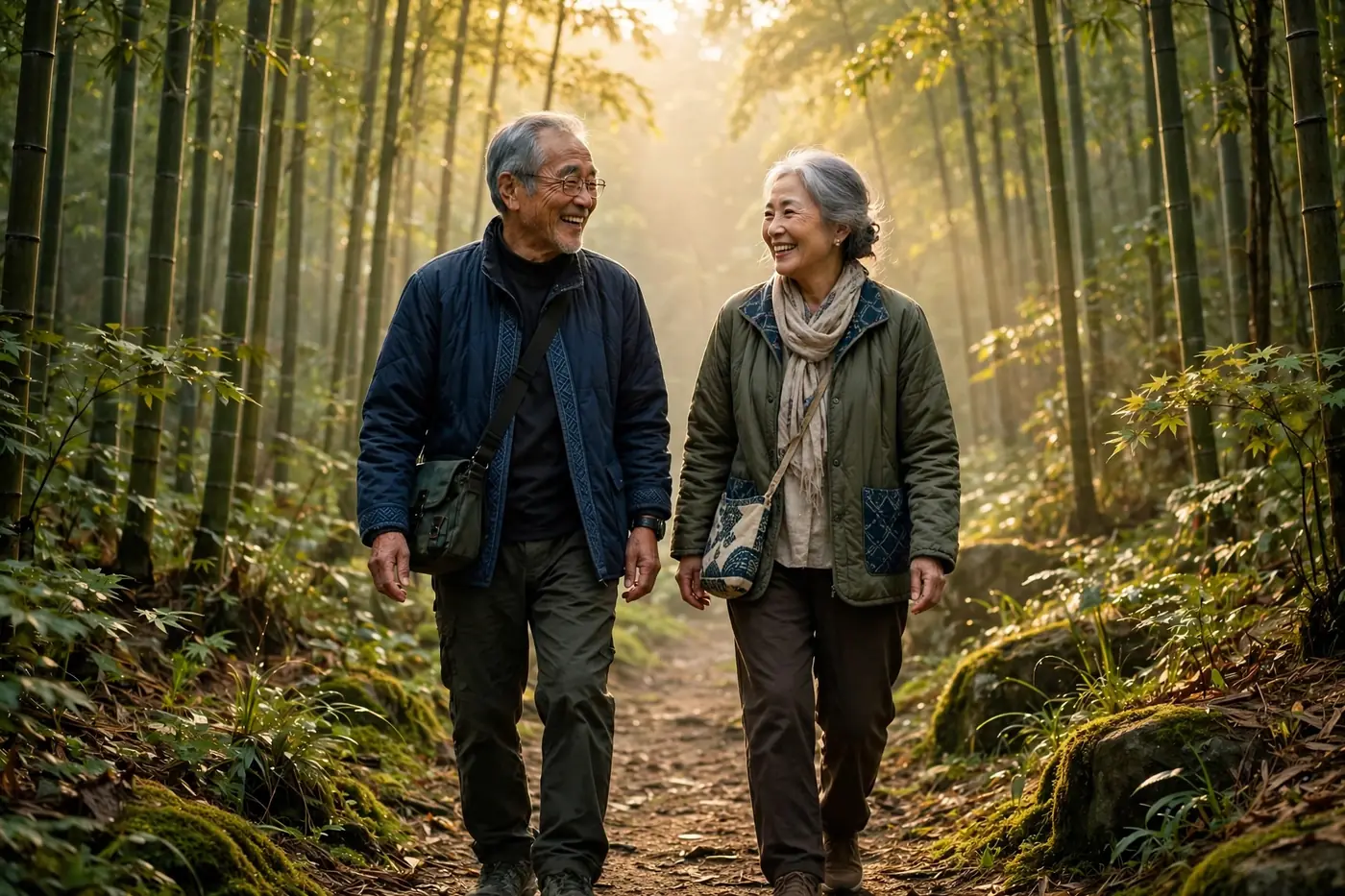
No app, no gym membership, no goal to hit. In most of the world's longest-lived communities, the movement that fills the day is not exercise at all — it is simply the walking that ordinary life requires, done slowly, often, and without ceremony.
Modern wellness culture tends to treat walking as the entry-level option — something to do until you're ready for "real" exercise. Traditional practice treats it almost the opposite way: as one of the most reliable, lowest-cost interventions available to the body, worth doing deliberately, every day, for its own sake.
The walk after the meal
Across Chinese and Japanese tradition alike, a short walk after eating is treated as part of the meal itself, not a separate activity. There is a Chinese saying, roughly translated: "walk a hundred steps after a meal, and live to ninety-nine." It is a folk saying, not a clinical guideline — but it points at something specific and now well documented: a gentle ten-to-fifteen-minute walk after eating measurably blunts the rise in blood sugar that follows a meal, more effectively than a walk of the same length taken at another point in the day.
The mechanism is straightforward. Working muscles pull glucose from the bloodstream directly, without waiting on insulin to do the job. A short walk, timed right after eating, puts that mechanism to work exactly when it is most useful.
Why slow and frequent beats hard and rare
Blue Zones research — the study of the handful of regions worldwide with the highest concentrations of people living past ninety — keeps returning to the same pattern: the people in these communities are rarely deliberate exercisers. They are gardeners, walkers to the market, people whose day naturally includes standing, bending, and moving on foot, dozens of times, without ever framing it as a workout.
This is a meaningfully different model from the modern default of intense exercise a few times a week bracketed by long stretches of sitting. A body moved gently and often appears to fare better, over decades, than a body moved hard and briefly. Frequency, in this picture, matters more than intensity.
Walking as a nervous-system practice, not just a cardiovascular one
Traditional walking practice is rarely just about the legs. A walk taken slowly, with attention on the breath and the surroundings rather than a destination or a pace target, functions as a form of moving meditation — closer in effect to gentle qigong than to a cardio session. The rhythmic, bilateral movement of walking has a measurable calming effect on the nervous system, independent of the physical exertion involved.
This is part of why a walk taken while distracted — phone in hand, mind elsewhere — delivers less of the calming benefit than the same walk taken with attention on the body and the breath, even at an identical pace.
Bringing it into an ordinary day
Walk after at least one meal a day. Ten to fifteen minutes, unhurried, ideally within thirty minutes of finishing eating.
Leave the phone in your pocket. Attention on the breath, the ground, and the surroundings, rather than a screen, is what turns the walk into a nervous-system practice rather than just transport.
Favour frequency over distance. Several short walks scattered through the day serve the body better than a single long one saved for the weekend.
Let it be unremarkable. The walk to the shop, the walk around the block after dinner, the walk to clear your head before a difficult conversation — none of these need to be reframed as exercise to count. Traditional practice never separated them from the rest of life in the first place.
The Harmony Path explores this same principle across a wider range of daily practices — the small, recurring movements and rituals that, together, form the foundation Chinese wellness tradition has relied on for centuries.
Sources
The post-meal glucose effect and the "gently and often" pattern are the best-supported claims here. Step-count and accelerometer studies are observational — they show a strong dose–response with mortality but cannot prove walking itself is the cause.
- Paluch AE, Bajpai S, Bassett DR, et al. Daily steps and all-cause mortality: a meta-analysis of 15 international cohorts. Lancet Public Health 2022;7(3):e219–e228.
- Ekelund U, Tarp J, Steene-Johannessen J, et al. Dose-response associations between accelerometry measured physical activity and sedentary time and all cause mortality: systematic review and harmonised meta-analysis. BMJ 2019;366:l4570.
- DiPietro L, Gribok A, Stevens MS, Hamm LF, Rumpler W. Three 15-min bouts of moderate postmeal walking significantly improves 24-h glycemic control in older people at risk for impaired glucose tolerance. Diabetes Care 2013;36(10):3262–3268.
- Buffey AJ, Herring MP, Langley CK, Donnelly AE, Carson BP. The acute effects of interrupting prolonged sitting time in adults with standing and light-intensity walking on biomarkers of cardiometabolic health: a systematic review and meta-analysis. Sports Med 2022;52(8):1765–1787.