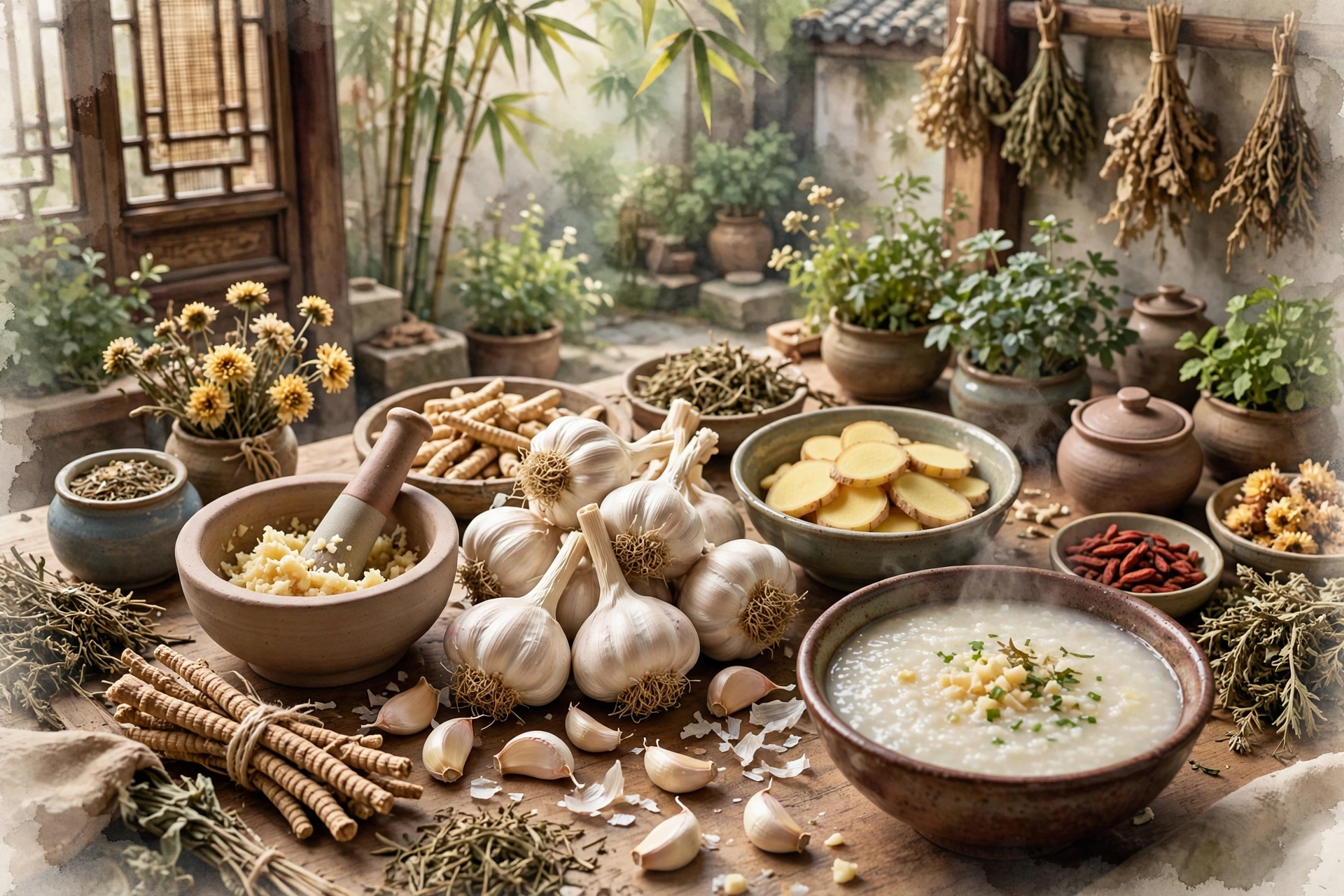
Bite into raw ginger and the mouth reacts before the mind does: warmth spreads across the tongue within seconds, sometimes a faint sweat follows. Bite into cucumber and the opposite happens, a cool, almost damp sensation that lingers after the bite is gone. Neither food has actually changed temperature. Something else is happening.
Traditional Chinese dietary therapy built an entire food classification system around exactly this sensation, centuries before anyone could explain the mechanism behind it. Modern sensory biology has since caught up with a surprisingly literal answer.
What "warming" and "cooling" actually means
In Chinese food therapy, every ingredient carries a thermal nature: warming, cooling, or neutral, alongside its more familiar nutritional properties. Ginger, cinnamon, lamb and chili are classed as warming. Cucumber, watermelon, mint and most raw leafy greens are classed as cooling. The system has nothing to do with the temperature a food is served at. A bowl of chilled watermelon and a bowl of hot ginger tea are still, respectively, cooling and warming by this logic.
The traditional advice follows from this: eat more warming foods in cold weather or when the body itself runs cold and sluggish, and lean toward cooling foods in hot weather or when the body runs flushed and irritable. It is a system of balance, not restriction.
The receptor science behind the sensation
Modern research into thermal transient receptor potential channels, TRP channels for short, gives this ancient classification a genuine physiological anchor. TRPV1, the same receptor activated by actual heat, is also activated by capsaicin in chili and by compounds in ginger, which is why these foods produce a real warming, sometimes sweating, response even at room temperature. TRPM8, the receptor tuned to cold, is activated by menthol in mint and related compounds, producing that cooling sensation regardless of the food's actual temperature.
This does not mean warming foods raise core body temperature or cooling foods lower it in any measurable clinical sense. What the research does confirm is that these foods are chemically triggering the body's own hot and cold sensing machinery, which is precisely the sensation the traditional system was built to track, long before anyone had a name for the receptor doing it.
Reading your own thermal signs
Traditional practitioners look for signs of imbalance rather than applying the system uniformly. A few markers commonly associated with each state:
Signs of running cold: cold hands and feet, a pale complexion, a preference for warm drinks, sluggish digestion.
Signs of running hot: a flushed face, a preference for cold drinks, irritability, a red tongue.
What to embrace when cold-leaning: ginger, cinnamon, warming broths, cooked grains, walnuts.
What to embrace when heat-leaning: cucumber, mint, watermelon, mung bean, leafy greens.
A simple way to apply it this week
The traditional practice is rarely about eliminating a whole category. It is about noticing a pattern, most people run persistently a little warm or a little cold, and nudging the week's meals gently in the opposite direction rather than overhauling every dish. A cold-leaning person adding a slice of ginger to their tea, or a heat-leaning person swapping one lunch for something built around cucumber and mint, is the entire practice in miniature.
Sources
TRP thermoreceptor research explains the sensory mechanism behind "hot" and "cold" foods; it does not establish that these foods change core body temperature.
- New insights into molecular mechanisms of "Cold or Hot" nature of food: When East meets West. Trends in Food Science & Technology, 2021.
- Food therapy and medical diet therapy of Traditional Chinese Medicine. Journal of Traditional Chinese Medical Sciences, 2017.