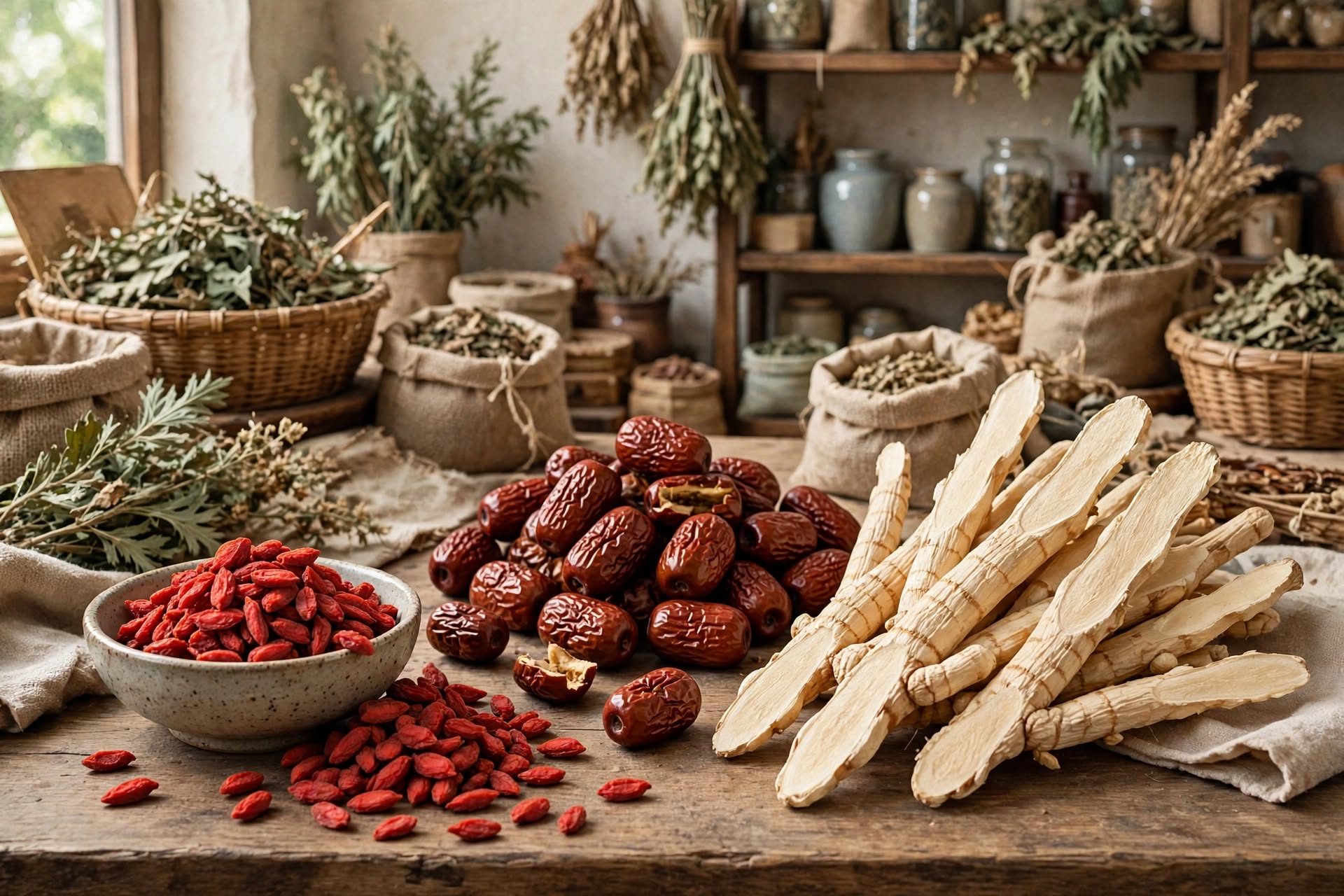
Walk into any Chinese grocery store and you'll find a section that looks, at first glance, like a spice aisle that wandered in from an apothecary. Dried red berries. Wrinkled reddish-brown dates. Pale, flat, tongue-depressor-shaped roots. These are tonic herbs, and unlike the exotic-sounding ingredients that show up briefly in wellness trends and disappear, three of them in particular have been simmered into Chinese home cooking for centuries: goji berries, jujube, and astragalus root.
This article is not a guide to herbal medicine, which in its full traditional form is a serious clinical practice requiring years of study and individual diagnosis. It is an introduction to three ingredients you can actually buy, actually cook with, and actually understand, so that if you encounter them in a recipe, a book, or a market stall, they stop being mysterious.
Goji berries: the one you've probably already seen
Goji berries (gou qi zi) are the small, red, slightly chewy dried berries that became a fixture of Western health food stores in the 2010s, often marketed with dramatic claims about antioxidants and superfruit status. Strip away the marketing and what's left is a real, long-used ingredient in Chinese cooking, traditionally added to soups, congee, and teas rather than eaten as a standalone snack.
In traditional use, goji berries are associated with supporting the eyes and what practitioners describe as nourishing "yin," a concept referring to the body's cooling, moistening, restorative aspects, as opposed to "yang," its warming, active aspects. Modern nutritional analysis confirms goji berries do contain notable levels of vitamin A precursors (carotenoids, including zeaxanthin) and vitamin C, nutrients genuinely linked to eye health in general nutrition science, which is a reasonable point of overlap between the traditional and modern framing, even if the mechanisms described differ.
How to use them: the simplest entry point is dropping a small handful into congee, soup, or a pot of tea during the last few minutes of cooking. They don't need to be cooked long, just rehydrated and warmed through.
Jujube: China's everyday dried date
Jujube (hong zao), often called Chinese red dates, is one of the most common ingredients in Chinese home kitchens, closer in everyday status to a bay leaf than to an exotic supplement. It has a mild, natural sweetness and a slightly chewy texture once cooked, and it appears constantly in soups, stews, and sweet dessert soups.
Traditionally, jujube is considered a gentle tonic for the digestive system and is often included in soups meant to be nourishing after illness, during recovery, or for new mothers in the postpartum period, a practice still widely observed in Chinese and broader East Asian households today. It's rarely used alone; it's almost always simmered alongside other ingredients, contributing sweetness so that less added sugar is needed elsewhere in the dish.
How to use them: a handful of jujube, simmered for 20 to 30 minutes in a pot of chicken or vegetable soup, adds a rounded natural sweetness. They can also be steeped in hot water alone for a simple, mildly sweet tea, especially popular in colder months.
Astragalus root: the quiet workhorse of herbal soups
Astragalus root (huang qi) is less familiar to Western cooks than goji or jujube, largely because it isn't eaten directly. It's a firm, pale root, usually sold sliced into flat strips, and it's simmered in soup for flavor and traditional benefit, then removed and discarded before eating, much like a bay leaf or a piece of kombu.
In traditional Chinese medicine, astragalus is one of the most frequently used herbs for supporting what's described as "wei qi," loosely translated as the body's protective or defensive energy, roughly comparable in traditional language to general resilience and immune function. It's a staple in herbal soup blends, often paired with jujube and sometimes goji, particularly in autumn and winter when households traditionally focus on "building up" the body before the colder months.
It's worth being direct here: astragalus has been studied in a modest but real body of modern research, mostly in China, looking at immune modulation and other effects, but much of this research uses concentrated extracts rather than the light broth infusion used in home cooking, and results are not considered conclusive by mainstream Western medical bodies. Treat traditional claims about astragalus as exactly that: traditional, plausible, and worth understanding, but not a substitute for evidence-based medical care.
How to use it: add 4 to 6 slices of dried astragalus root to a pot of soup at the start of cooking, let it simmer alongside your other ingredients for at least 30 minutes, and remove the slices before serving. It has a mild, faintly sweet, woody flavor that mostly disappears into the broth rather than dominating it.
A simple three-herb soup to start with
For a first, low-commitment experiment, a classic and very forgiving combination: 6 slices of astragalus root, a small handful of jujube (5 to 6 dates), and a tablespoon of goji berries (added in the last 10 minutes), simmered in chicken or vegetable stock with a piece of ginger for about 45 minutes. Season simply with salt. This is close to what many Chinese households would recognize as an everyday "nourishing soup," not a special medicinal preparation, just an ordinary Tuesday dinner with a long history behind it.
Where to buy them
All three are widely available dried, either in Chinese or broader Asian grocery stores, or online. Look for goji berries that are a deep, uniform red without excessive stickiness (a sign of added sugar or poor storage), jujube that feel firm rather than rock-hard, and astragalus root that's a consistent pale cream color. None of these ingredients require special storage beyond a sealed container in a cool, dry cupboard.
Frequently asked questions
Are these herbs safe to combine with medication?
Astragalus in particular can interact with immunosuppressant medications and is generally not recommended for people who have had organ transplants or take medication to suppress the immune system, since it's traditionally believed to stimulate immune activity. If you take prescription medication of any kind, check with a doctor or pharmacist before making these a regular part of your diet, especially in concentrated or supplement form.
Can I eat astragalus root directly?
It's fibrous and woody, not pleasant to eat whole. It's almost always simmered for flavor and then discarded, the same way you would treat a bay leaf.
Is there a difference between goji berries sold as "health food" and the ones in an Asian grocery store?
Usually not in any meaningful way, aside from price. The same dried goji berries sold at a premium in Western health food packaging are typically the same product available for less in Asian grocery stores.
Do these herbs actually boost immunity, as often claimed?
"Boost immunity" is a vague, frequently overused marketing phrase that doesn't map cleanly onto how the immune system actually works. Astragalus has some genuine research interest in immune modulation, but claiming any food or herb reliably "boosts" immunity, as though it were a dial you could turn up, oversimplifies a complex system. Traditional use and general nutritional value are on firmer ground than immune-boosting claims.
Pantry, not pharmacy
Goji, jujube, and astragalus are not mysterious superfoods requiring special rituals. They're pantry ingredients with centuries of ordinary use behind them, most often simmered quietly into a pot of soup rather than ceremonially prepared. Understanding what they traditionally are, and what current evidence does and doesn't support, is a more useful starting point than either dismissing them or expecting them to work miracles.
For readers who want to go deeper into any single ingredient here, The Goji Berry Miracle focuses specifically on goji's traditional and modern uses in far more detail than this introduction allows.
Related reading: Understanding the Gut Microbiome, The Taoist Breathing Practice Behind Longevity, What Modern Geroscience Says About Taoist Longevity Practice, Congee: The Quietest Breakfast in the World, and the Okinawan diet.
Sources
Human evidence for these three is thin. Goji has the most: a few small trials on its carotenoids (zeaxanthin) and macular pigment. Jujube and astragalus rest mainly on traditional use and lab or animal work. Treat them as foods, not treatments.
- Li X, Holt RR, Keen CL, Morse LS, Yiu G, Hackman RM. Goji berry intake increases macular pigment optical density in healthy adults: a randomized pilot trial. Nutrients 2021;13(12):4409.