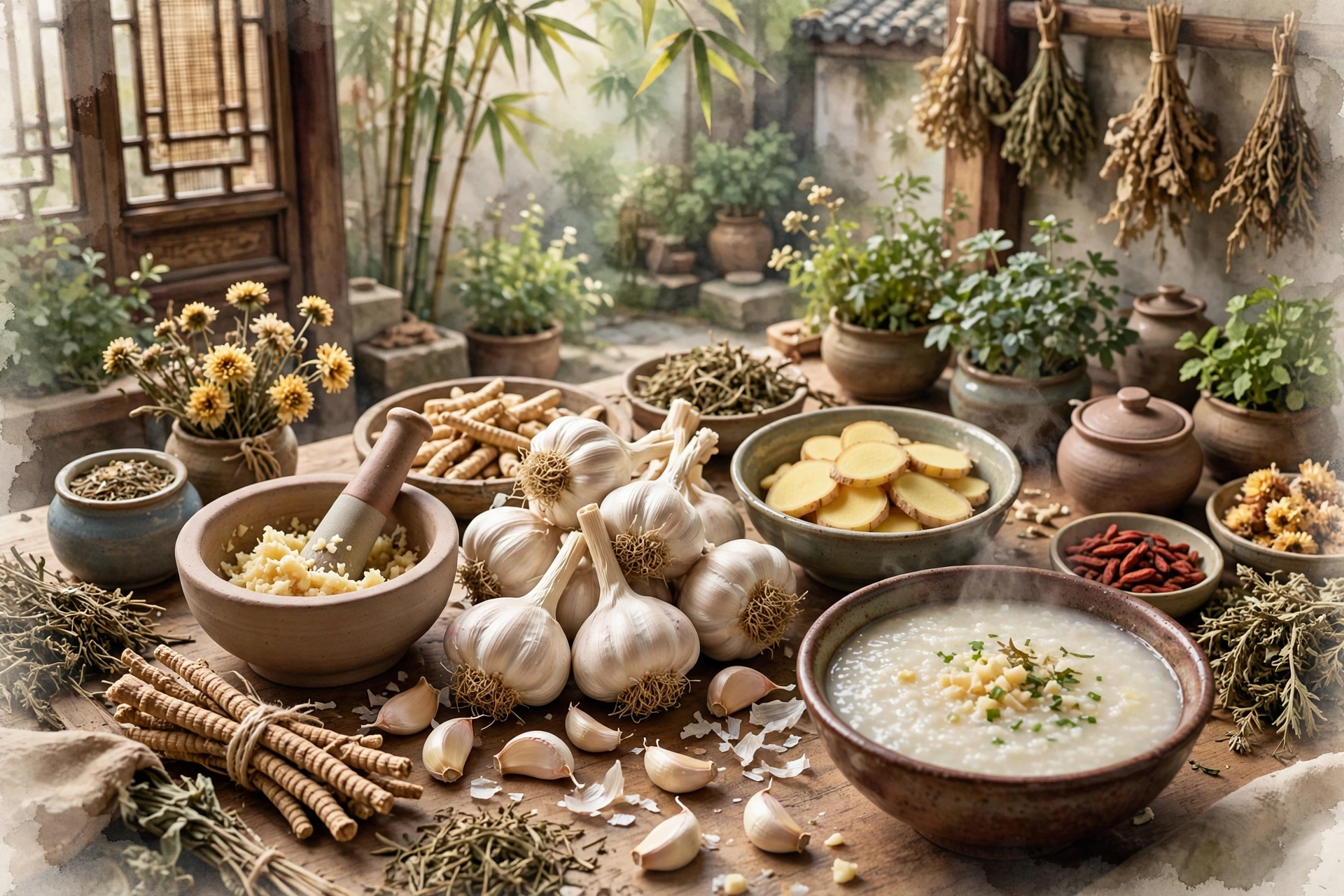
Garlic sits in nearly every kitchen on earth, which is exactly why it's easy to underestimate. It is cheap, it is common, and it has been treated as more than a flavoring in the Chinese kitchen for a very long time. Long before pharmacies existed, garlic was one of the first things reached for when someone in the household felt a chill coming on, or complained of a heavy stomach after a rich meal.
This article looks at how garlic has traditionally been used in Chinese food culture and folk medicine, separates that from what modern research can and cannot confirm, and gives a few practical, low-effort ways to eat more of it without irritating your digestion.
Garlic's place in traditional Chinese food culture
In the framework of Chinese dietary therapy, foods are often described by their perceived temperature and their effect on the body's energy, or qi, rather than purely by their nutrient content. Garlic is classified as a warming food, alongside ginger, cinnamon, and scallions. Warming foods are traditionally recommended in colder months, for people who feel the cold easily, or to counteract the heaviness of fatty or raw foods.
This is a cultural and culinary framework, not a biochemical one, and it predates modern nutritional science by centuries. It is worth naming clearly: "warming" in this tradition does not mean garlic literally raises your body temperature in a measurable way. It describes a traditional pattern of use, developed through generations of observation, about which foods pair well with which conditions and seasons.
Garlic shows up constantly in everyday Chinese cooking for exactly this reason. It's stir-fried with leafy greens to "balance" their cooling nature, added generously to meat dishes in winter, and pickled in vinegar (a preparation called laba garlic) to eat alongside heavier Lunar New Year meals, when a small sharp, acidic bite is thought to cut through richness.
What modern research actually supports
Separately from its traditional classification, garlic has been studied fairly extensively in modern nutrition science, mostly for its sulfur compounds, particularly allicin, which forms when raw garlic is crushed or chopped and its cells are damaged.
Some findings worth knowing, stated carefully:
- Several clinical studies have found modest reductions in blood pressure and cholesterol with regular garlic consumption, though effect sizes vary significantly between studies and are generally smaller than what medication would achieve.
- Garlic has documented antimicrobial properties in laboratory settings. Whether eating garlic translates this into a meaningful real-world effect against infections in humans is much less established.
- Some research suggests garlic may support healthy circulation, which aligns loosely, though not precisely, with its traditional "warming" reputation.
What garlic is not: a proven treatment for any disease, a substitute for medical care, or something with dramatically different effects depending on which color or variety you buy. Claims that garlic "cures" infections, prevents cancer, or works better than medication are not supported by current evidence and should be treated with skepticism regardless of where you encounter them.
How to actually eat more of it (without regretting it)
The gap between "garlic is good for you" and "I eat garlic every day" is usually about texture, breath, and stomach comfort. A few practical approaches that traditional and modern cooks both rely on:
1. Crush it, then let it rest.
Allicin only forms once garlic is cut or crushed, and it needs a few minutes of contact with air to fully develop. If you're chopping garlic for a dish, do it first, set it aside for 10 minutes, and cook everything else. This small habit preserves more of garlic's active compounds than tossing it straight into a hot pan.
2. Cook it gently if raw garlic upsets your stomach.
Raw garlic is more pungent and, for some people, harder to digest. Traditional Chinese cooking rarely serves large amounts of it raw; it is usually cooked briefly in oil at the start of a stir-fry, which mellows both the heat and the digestive impact while keeping most of the flavor.
3. Try black garlic if the smell is the real barrier.
Black garlic, made by slowly fermenting whole bulbs at low heat over several weeks, has a soft, almost sweet, molasses-like flavor and none of the sharp bite of raw garlic. It isn't classical Chinese medicine, but it's a genuinely useful bridge for people who want garlic's flavor without the aftermath.
4. Add it at the start of soups and broths, not just stir-fries.
A traditional home remedy for the first signs of a cold in many Chinese households is a simple soup: garlic, ginger, and scallion simmered briefly in water or broth. There's no strong clinical evidence that this shortens a cold, but it is a genuinely comforting, low-risk habit, and warm liquids do help with congestion and hydration regardless.
A word of caution
Garlic is not risk-free for everyone. It can interact with blood-thinning medications, including warfarin, and people scheduled for surgery are often advised to stop high-dose garlic supplements beforehand due to bleeding risk. Large amounts of raw garlic can also irritate the stomach lining in people prone to acid reflux or ulcers. If you take blood thinners, have a bleeding disorder, or have a sensitive digestive system, talk to a doctor or pharmacist before significantly increasing your garlic intake, especially in supplement form, which delivers much more concentrated doses than food.
Frequently asked questions
Does garlic really help with colds?
There isn't strong clinical evidence that garlic prevents or cures colds. It has a long folk history as a comfort food during illness, and warm garlic-based soups can genuinely help with hydration and congestion, but this is different from garlic curing an infection.
Is raw garlic more "medicinal" than cooked garlic?
Raw garlic contains more allicin immediately after crushing, since heat can break this compound down. If you want the maximum traditional and nutritional benefit, crushing garlic and letting it sit for a few minutes before light cooking is a reasonable middle ground.
How much garlic is considered a normal daily amount?
There's no single official figure, but one to two cloves a day is a commonly cited, food-based amount used in several nutrition studies. This is a modest culinary quantity, not a supplement-level dose.
Can I take garlic supplements instead of eating garlic?
You can, but supplements are concentrated and carry more risk of interactions and side effects than food-level amounts. Whole food garlic, used in cooking, is the lower-risk starting point for most people.
The everyday remedy
Garlic is one of the rare ingredients where traditional wisdom and modern nutrition science actually point in roughly the same direction, even if they use completely different language to describe it. Chinese food culture calls it a warming food that supports digestion in the cold months. Modern research finds modest, real cardiovascular and antimicrobial effects. Neither claims it's a miracle. Both agree it belongs in your kitchen more often than as an afterthought.
If this kind of practical, food-as-medicine thinking resonates with you, Garlic: From Ancient Remedies to Modern Marvels goes much deeper into garlic's history and traditional preparations across cultures, not only in China.
Related reading: Anti-Inflammatory Foods in Chinese Medicine, Chronic Inflammation and Traditional Chinese Medicine, The Okinawan Diet, and Understanding the Gut Microbiome, and How to Start Fermenting at Home.
Sources
The blood-pressure and cholesterol effects are real but modest — well below what medication achieves, and mainly in people who already have elevated readings. The antimicrobial activity is well documented in the lab; the real-world anti-infection benefit of eating garlic is not established.
- Ried K, Frank OR, Stocks NP, Fakler P, Sullivan T. Effect of garlic on blood pressure: a systematic review and meta-analysis. BMC Cardiovasc Disord 2008;8:13.
- Ried K, Toben C, Fakler P. Effect of garlic on serum lipids: an updated meta-analysis. Nutr Rev 2013;71(5):282–299.
- Ankri S, Mirelman D. Antimicrobial properties of allicin from garlic. Microbes Infect 1999;1(2):125–129.